The Philippines has one of the highest rates of school bullying in the world: one in every three students is bullied at least once a week, according to the international Organisation for Economic Co-operation and Development (OECD). Ateneo de Manila University researchers are now looking at ways to empower Filipino parents to help address and prevent bullying to complement school efforts.
Empowerment begins with a deep dialogue with the parents to better understand their concerns and experiences. This is crucial, as parents are well-positioned to recognize early warning signs and provide immediate support outside of school.
Rather than simply treating parents solely as learners or recipients of anti-bullying information, researchers from the Department of Psychology and the Department of Information Systems and Computer Science took a participatory approach to the design process. They invited parents of public school students to explore ideas for bullying-prevention materials, which were then developed and refined through feedback from the communities they were intended to reach.
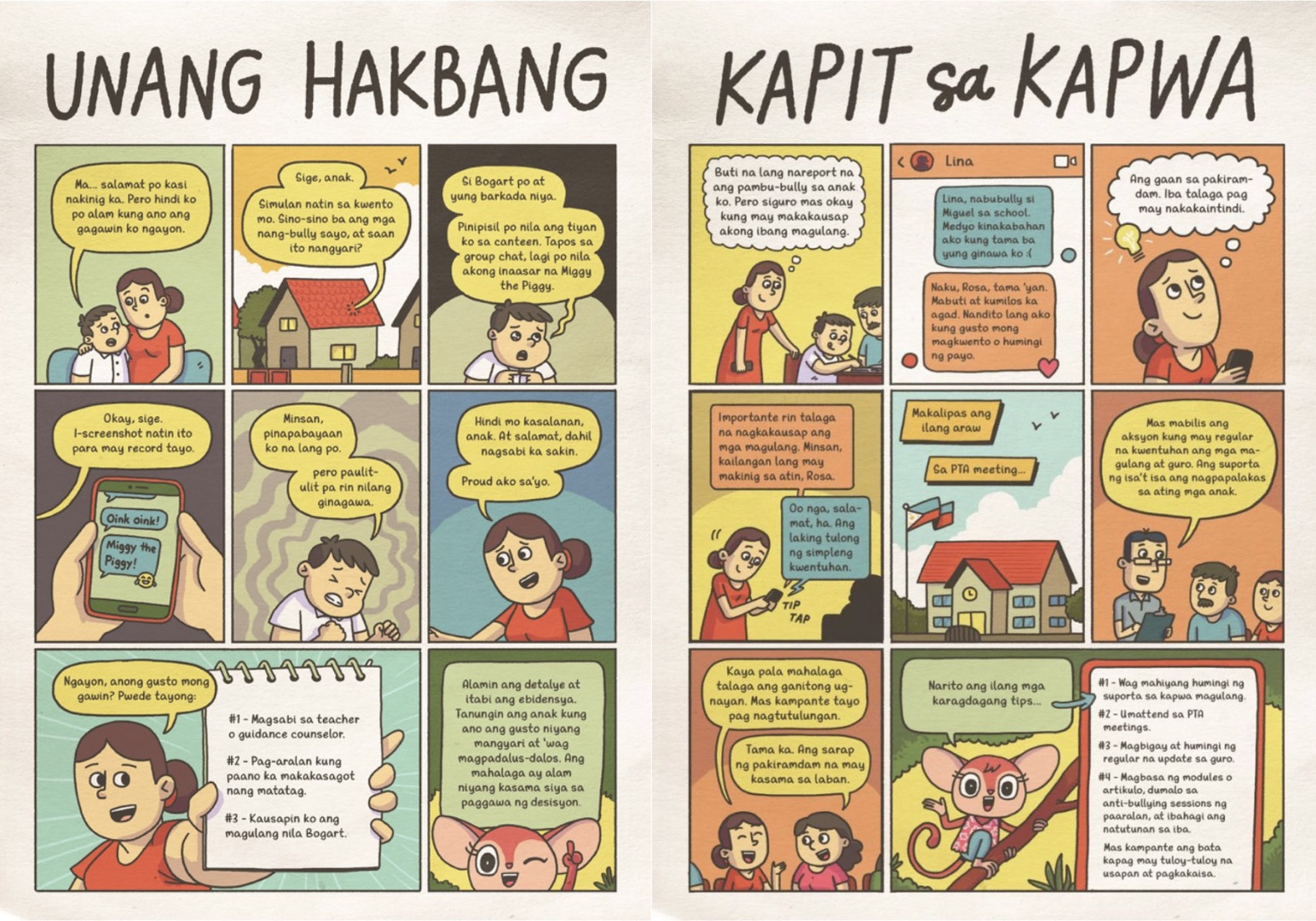
Parents suggested using an accessible medium: comic strips.
Once the comics were developed, they were shared back to parents to make sure that they were relevant. Notably, the parents challenged conventional portrayals of family roles: they called for fathers to be represented as actively involved in their children’s emotional well-being, rather than positioning empathy as primarily a maternal role. Revisions consequently depicted both parents participating in conversations about bullying, including a father who recognizes and apologizes for an initially unhelpful response to his child’s experience.
Other recommendations led to clearer language, more accessible visuals, and more realistic guidance on how families should work with schools to address bullying.
These changes reflect the project’s central principle of moving from “designing for users” to “designing with users.” By incorporating parents’ lived experiences into the development process, the researchers sought to make bullying-prevention materials more relatable, culturally grounded, and practical.
The comics are part of a larger, ongoing bullying-prevention project rather than a one-time finished intervention. The revised materials will serve as evidence-informed storyboards for short informational reels intended for further use and evaluation with parents in partner public schools.
The project demonstrates how prevention materials can evolve when the communities they are intended to serve are given a role in creating them.