
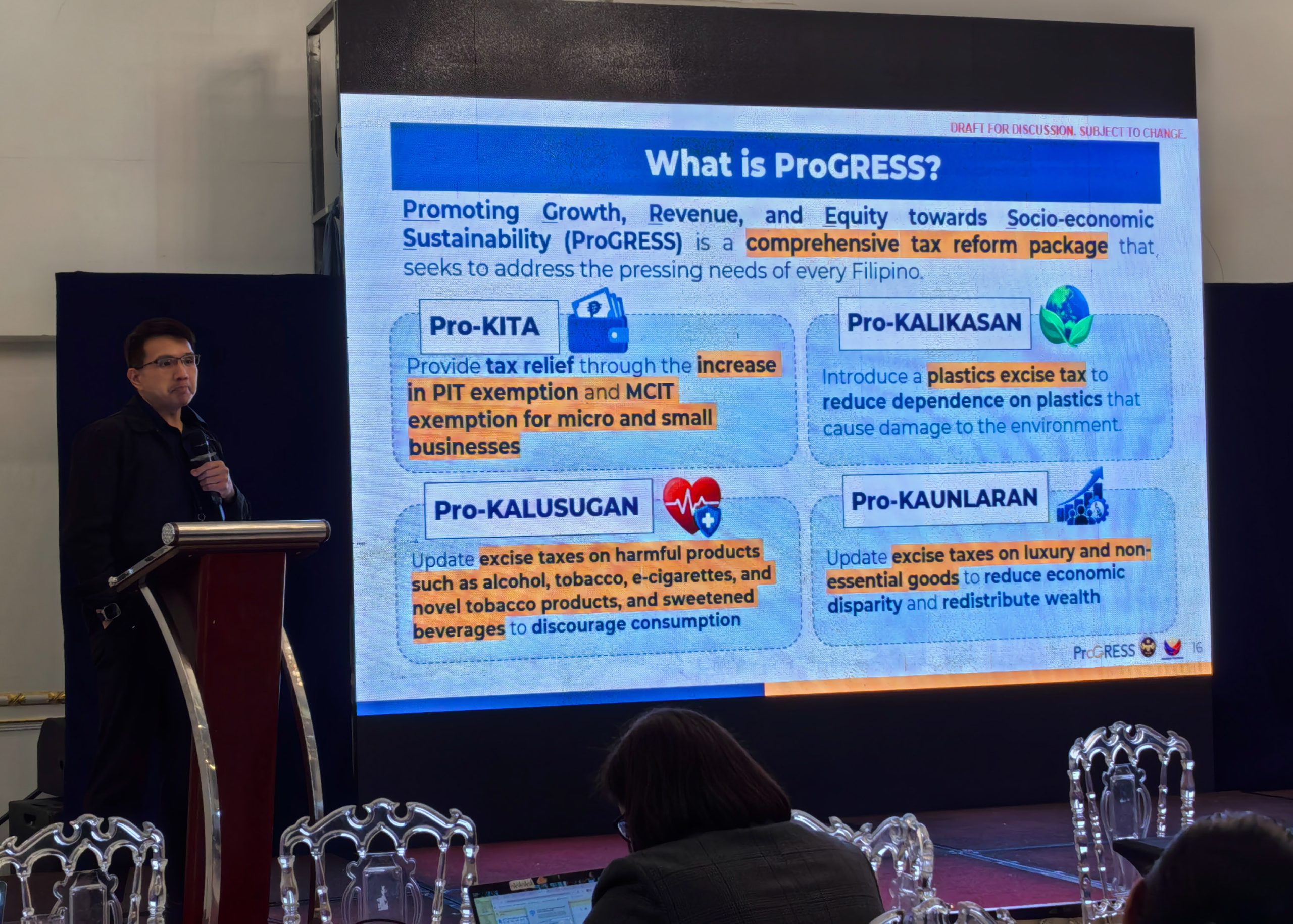
A proposed tax overhaul by the Philippine Department of Finance seeks to deliver immediate financial relief to more than 3 million middle-class workers and small businesses struggling with inflation and stagnant purchasing power.
During a stakeholder briefing, the Promoting Growth, Revenue, and Equity towards Socio-Economic Sustainability (ProGRESS) tax package raises personal income tax exemption thresholds and eliminates minimum corporate income taxes for small firms operating at a loss. To finance the relief measures, the government plans to raise levies on sugary beverages, vapes, single-use plastics, and luxury goods.
According to Department of Finance data, while nominal wages have risen through periodic salary adjustments, stagnant real wages have created “bracket creep”—pushing ordinary workers into higher tax brackets without increasing their actual buying power. Currently, an estimated 30% of Filipino households, including middle-class families, remain vulnerable to falling into poverty following economic shocks.
Under current tax brackets, an entry-level public school teacher earning an annual basic salary of P380,460 who was tax-exempt in 2018 saw their tax liability climb to P15,407.57 in 2026 purely due to mandatory salary standardization increases.
Under the ProGRESS proposal, the personal income tax exemption threshold will rise from P250,000 to P350,000. The adjustment will benefit 3.13 million individual taxpayers—96% of whom belong to lower-middle and middle-income groups—generating annual tax savings between P15,000 and P17,500.
With the expanded exemption, tax due for an entry-level teacher will fall to P407.56, yielding P15,000 in annual savings. A public hospital nurse earning P645,816 annually will see their tax bill drop from P68,856.63 to P51,356.63, saving P17,500 per year.
The legislative package also provides targeted relief to 78,000 micro and small enterprises by exempting firms with gross sales under P20 million from the 2% Minimum Corporate Income Tax (MCIT). Under existing tax law, small businesses must pay the 2% levy on gross income even when operating at an annual loss.
Under ProGRESS, a micro-bakery suffering a net operating loss of nearly P95,000 —which currently owes P11,271 in MCIT—would see its tax liability erased. A small neighborhood cafe generating P11.5 million in gross sales but incurring net losses would save P40,273 annually.
To offset the revenue forgone from income tax cuts, the government proposes shifting the tax burden toward negative externalities and discretionary wealth.
The framework increases excise taxes on sweetened beverages from P6 to P20 per liter, establishes tax parity for e-cigarettes and traditional cigarettes at P72.93 per pack alongside a P150 tax per vape device, and introduces a P150-peso-per-kilogram tax on single-use plastics.
The proposal also introduces a 75% tax tier for ultra-luxury automobiles valued over P8 million, expands the 25% non-essential goods tax to private aircraft and yachts, and implements a 15% Global Minimum Tax expected to collect P24.4 billion annually from 1,001 multinational corporate groups. Roderick Osis