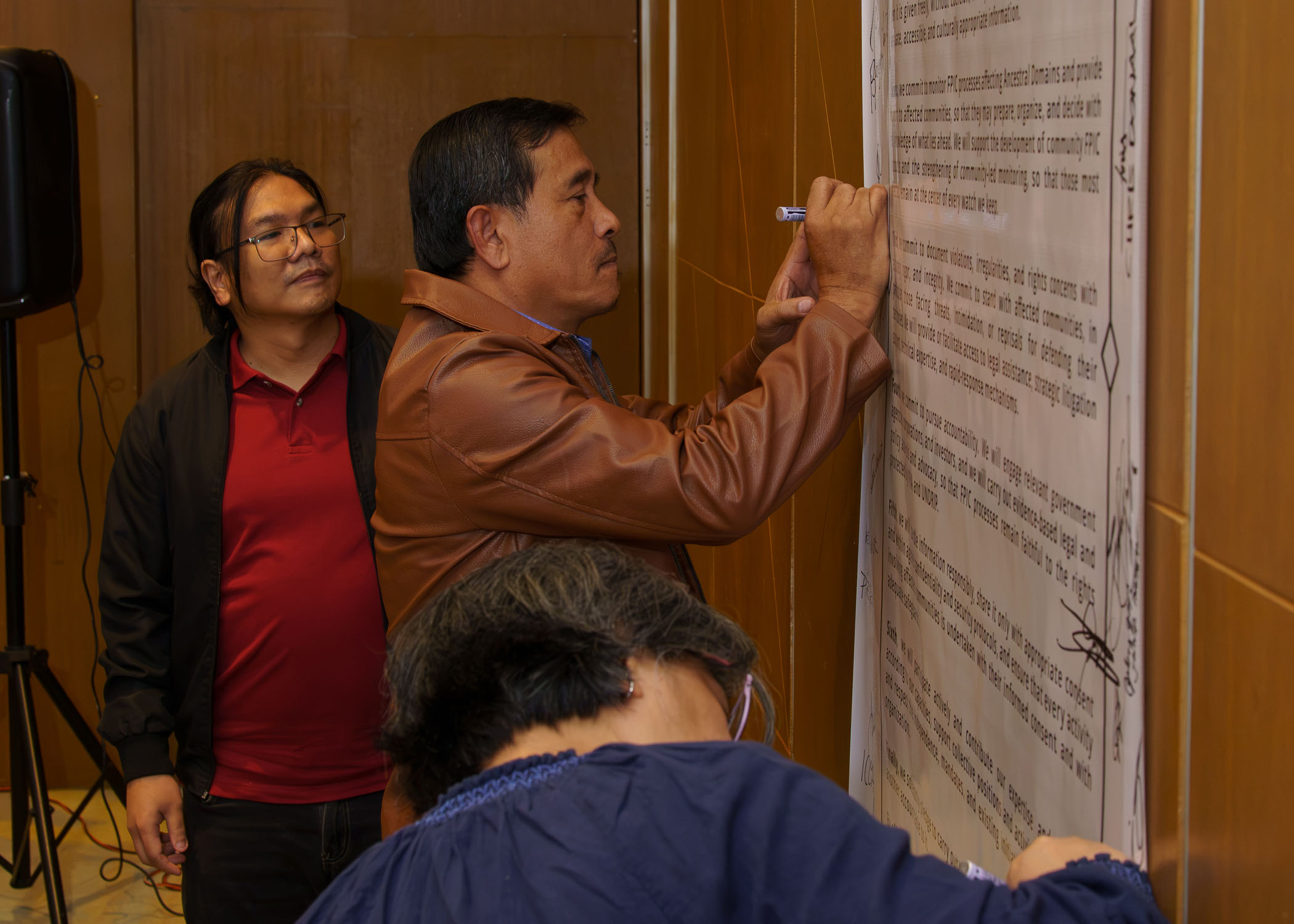
Following its official launch on Friday (Nov. 6), FPIC Watch – Philippines unveiled its two-year action plan including resort to legal remedies to the recently revised Free Prior and Informed Consent (FPIC) Guidelines, among others.
FPIC Watch was formally founded by 40 Indigenous Peoples’ organizations, legal and academic institutions, human rights and civil society groups, and media organizations after a two-day convening. It established a coordinated network that connects community experiences with legal analysis, technical evidence, research, and rights-based policy advocacy.
“While the new FPIC Guidelines may already be ready for implementation, there is still an opportunity to seek appropriate interim measures while the concerns we have raised are being addressed. This is not to impede implementation, but to ensure that the Guidelines are implemented in a manner that is rights-based, responsive to the concerns of Indigenous Peoples, and consistent with the objectives of the IPRA,” said lawyer Raymond ‘Ice’ Baguilat of the UP Institute of Human Rights – Indigenous Peoples Law and Policy Program.
Baguilat was selected as among the initial four convenors of the newly created watchdog together with Beverly Longid of the Kalipunan ng Katutubong Mamamayan ng Pilipinas (KATRIBU), Atty. Rowena Lagasca of Reynaldo Alabanza Cortes Law, and Sagada, Mt. Province elder Michael Umaming.
He added that the new guidelines did not undergo thorough consultation with the Indigenous communities who stand to be affected by its flawed provisions.
FPIC entitles Indigenous Peoples to give or withhold consent to any project, policy, or activity that affects their lands, territories, resources, or customary rights.
“The government has still to resolve issues that arose because of the implementation of the 2012 FPIC guidelines, yet it wants us to just embrace this new one,” said Lagasca, whose office co-hosted the convening with Indigenous Peoples Rights International and Cordillera Human Rights Alliance.
Among FPIC Watch’s action plan includes community-led monitoring and documentation of FPIC processes and alleged violations, strengthening of access to legal and technical support, promotion of community capacity-building, and pursuing accountability for violations involving relevant government agencies and corporate actors.
“We are elated and excited to be part of this network because we now have assistance in defending our rights, especially for our communities who lack technical and legal knowledge,” said Ayta Magindi member Rica Torres, who represented Mansaway, a local Aeta organization, in Filipino.
Based on data collected and analyzed by the Philippine Association for Inter-Cultural Development (PAFID), almost all Key Biodiversity Areas (KBA) in the country are located in Ancestral Domains of Indigenous communities.
KBAs are areas on land or water which contribute significantly to the conservation of biodiversity.
“That is why we need to have a mechanism so strong and ironclad to protect and ensure that all activities within Indigenous Peoples territories are beneficial and not destructive, especially to IPs who are stewards of these KBAs,” said PAFID Executive Director Dave de Vera.
De Vera said a spatial mapping analysis conducted this year revealed that Indigenous ways have been responsible “to a great extent” in protecting the remaining forests in the country where most of our KBAs are located.
Nearly 80% of all officially NCIP-recognized Ancestral Lands/Domains and Indigenous Territories are located within Critical Watersheds and Protected Areas in the Philippines.