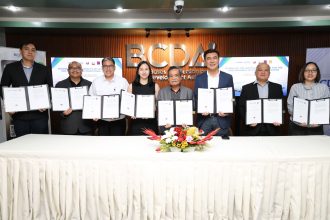

Administrative/Procurement officers of the Local Government Unit of Baguio and national line agencies were oriented on the Pansa-nopen tayo Circular Economy transition guidelines for government office events and activities, at the Baguio Convention and Cultural Center (BCCC), Tuesday, Jan. 6, 2026.
The competencies as crafted from inputs through the city’s Local Circular Economy Action Team (LCEAT) were presented by City Planning Development and Sustainability Office (CPDSO) Coordinator Archt. Donna Rillera-Tabangin, following guidance from Mayor Benjamin Magalong, lectures and sharing from City Budget Officer Atty. Leticia Clemente and General Services Office (GSO) Supply Division Chief Atty. Cherrybeth Batuna.
The activity is a recognition of the strategic role of procurement and supply officers in institutionalizing circular economy principles within government operations, most especially in “promoting sustainable procurement, efficient resource utilization and waste reduction,” the rationale states.
A shift from the linear “take-make-dispose” process, the CE program is for waste minimization and resources is used as long as possible through strategies, among which may be repair, reuse, refurbish, remanufacture and recycle.
The eight-point guidelines are for planning and design, procurement and materials specification, zero waste and material recovery, food and catering, energy and water use, transportation and mobility, communication and awareness, and measurement and continuous improvement.
The details for the program were:
• Government events should be planned with circular thinking for the design, materials, energy and load, in compliance with the green procurement act (New Government Procurement Act or RA 1009) such that sustainability objectives for venue, suppliers and energy efficiency are measurable, with consideration for seasonal and plant-based menus from local farmers and entrepreneurs, through a green supplier list to minimize food miles and carbon footprint, uphold recycling programs and waste diversion rates;
• Materials including furniture, cutlery, and other items for the event/meeting should be reusable/recyclable, rented, reused for future events, and/or made from recycled/upcycled content;
• For the food and catering; employees/attendees are encouraged to bring reusable mugs/food/drink containers, water/drinks should be in dispensers with drinks in aluminum cans as second option, and there should be no straws nor drinks in multi-layered packaging;
• Food portion should be planned and served in realistic amounts as unconsumed food ends as waste. The use of reusable covers is encouraged, and caterers should partner with organizations for food rescue/redistribution organization, or those who compost food scraps; Decorations, ribbons, balloons, leis and materials including tarpaulin signages for single use only should be refused. Giveaways and promotional items that are disposable or non-recyclable should be avoided, with useful digital or sustainable and creative alternatives as option;
• Paper should be recycled/reused while pens should be refillable. Caution is given that bamboo spoons and paper cups end up in the trash;
• Invitations, programs, tickets and paper-based materials could be sent in digital form, and virtual events should be considered whenever possible, as this reduces physical attendance and transportation emissions;
• A waste sorting station for recyclables, compostables and general waste should be implemented and monitored, with clear labels; located in visible areas and along the general circulation area of the office/venue
• Collaborative partners should be identified to ensure that materials are collected, properly processed and recycled/repurposed and for unavoidable waste, upcycling or donation options are explored;
• For energy and water use during activities in office venues, minimized resource consumption and renewables should be promoted, and verified; through renewable energy/solar power, use of LED fixtures, optimized natural lighting and ventilation, minimized/efficient air conditioners. Water refill stations should be installed in strategic areas within the facility.
• To reduce travel impact and promote low-carbon options, the use of public transport is encouraged, as with cycling, carpooling or walking, with the provision of electric vehicle charging point where possible;
• Fuel usage of government vehicles should be monitored, as to RA 11285;
• In compliance to the Extended Producers Responsibility (EPR); reusable, repairable and recyclable products are prioritized, or a return to manufacturer order prevails.
• There should be impactful IEC for awareness and to embed circular economy culture in the workplace, to educate staff, participants and vendors/suppliers about CE principles and goals; and
• Signages should be displayed explaining sustainability measures during events. Success stories regarding waste diversion and emission avoidance may be shared while sustainable behavior regarding CE should be recognized and rewarded within offices.
To measure success and areas of improvement, pre and post waste audits should be done; as with a green scorecard to track, to monitor, report, evaluate and refine CE practices with a green star to be given to compliant offices/establishments, Archt. Tabangin said
.
Suggestions and recommendations, however, are welcome to improve or upgrade the guidelines. – Baguio City Public Information Office