
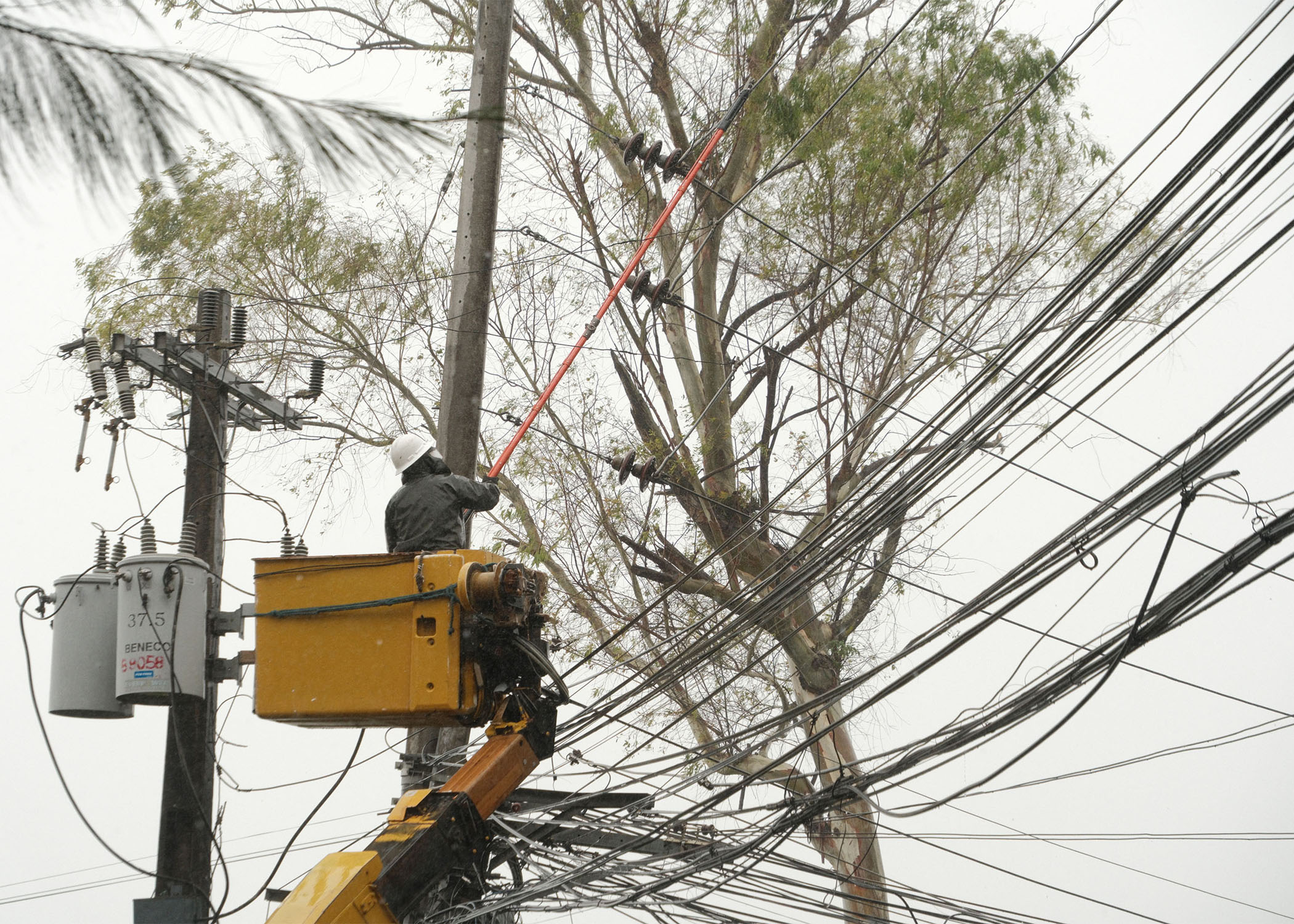
The City Council and the Benguet Electric Cooperative (Beneco) are pushing telecommunications companies to clear dangling wires and looks into the possibility of transitioning to underground cables to eliminate the longstanding public nuisance.
During a council session on July 13, Councilor Jose Molintas raised concerns over abandoned utility lines attached to Beneco poles, noting that telcos often leave dead cables behind rather than removing them.
“Ang problem po kase sa dangling wire, pag may namatay silang linya, instead of removing and replacing that, they simply put a new one, kaya dumarami,” Beneco general manager Melchor Licoben said.
Licoben added that utility providers are transitioning from bulky copper lines to fiber optics to help declutter the poles.
To enforce accountability, Molintas urged the city government to join future pole-sharing contracts between Beneco and telecommunications companies under Baguio’s anti-nuisance ordinance.
“Dapat sila managot. We can in fact give them notice and then remove them and require them to pay expenses in removing these dangling wires,” Molintas said.
Councilor Fred Bagbagen highlighted a pilot underground cabling agreement between the city mayor and telcos.
While Beneco supports the initiative, Licoben emphasized that long-term success requires coordination with national agencies.
“We should go beyond the telcos kung seseryosohin natin yung underground, pero kailangan kase dito ang DPWH kase sila yung may control sa kalsada,” Licoben said, referring to Beneco’s proposal for the Department of Public Works and Highways to coordinate road excavations with public utilities.
Licoben confirmed that moving lines underground remains a priority for the cooperative.
“Ang dami nating gagawin, but it is part of our long-term plan,” Licuben said.
Licoben, during the City Council session last week that while the cooperative has maintained a comprehensive technical blueprint to place the city’s chaotic wires underground for the last 15 years, funding remains the primary roadblock saying the power distributor is a non-profit cooperative and cannot shoulder the project’s massive capital expenditures (CapEx) alone without heavily impacting consumer power rates.
According to Beneco’s estimates, burying just 11 kilometers of power lines would add 50 centavos per kilowatt-hour to local consumers’ electricity bills.
On June 15, 2026, the Baguio City Council approved on first reading a proposed ordinance authored by Councilor Edison Bilog.
The pending measure mandates the progressive relocation of all overhead utility and communication lines underground within five years from the establishment of a Common Underground Utility Corridor (CUUC).
The proposed ordinance, which has been referred to the Committee on Public Utilities, Transportation, and Traffic Legislation for review, applies to all public and private utility providers, including telecommunications firms, internet service providers, and electric distribution utilities.
It also features a “Dig-Once Policy” to prevent repeated road diggings and creates a dedicated Baguio Underground Utilities Management Council to enforce compliance. Non-compliant entities face administrative penalties, including daily fines and the potential withholding of permit renewals.
The proposed measure provides that the city government shall establish and maintain the Common Underground Corridor System, with the responsibility for implementing underground cabling-related projects not being placed on BENECO. Noemi Salatic | UC Intern with a report form Baguio City Council PIO