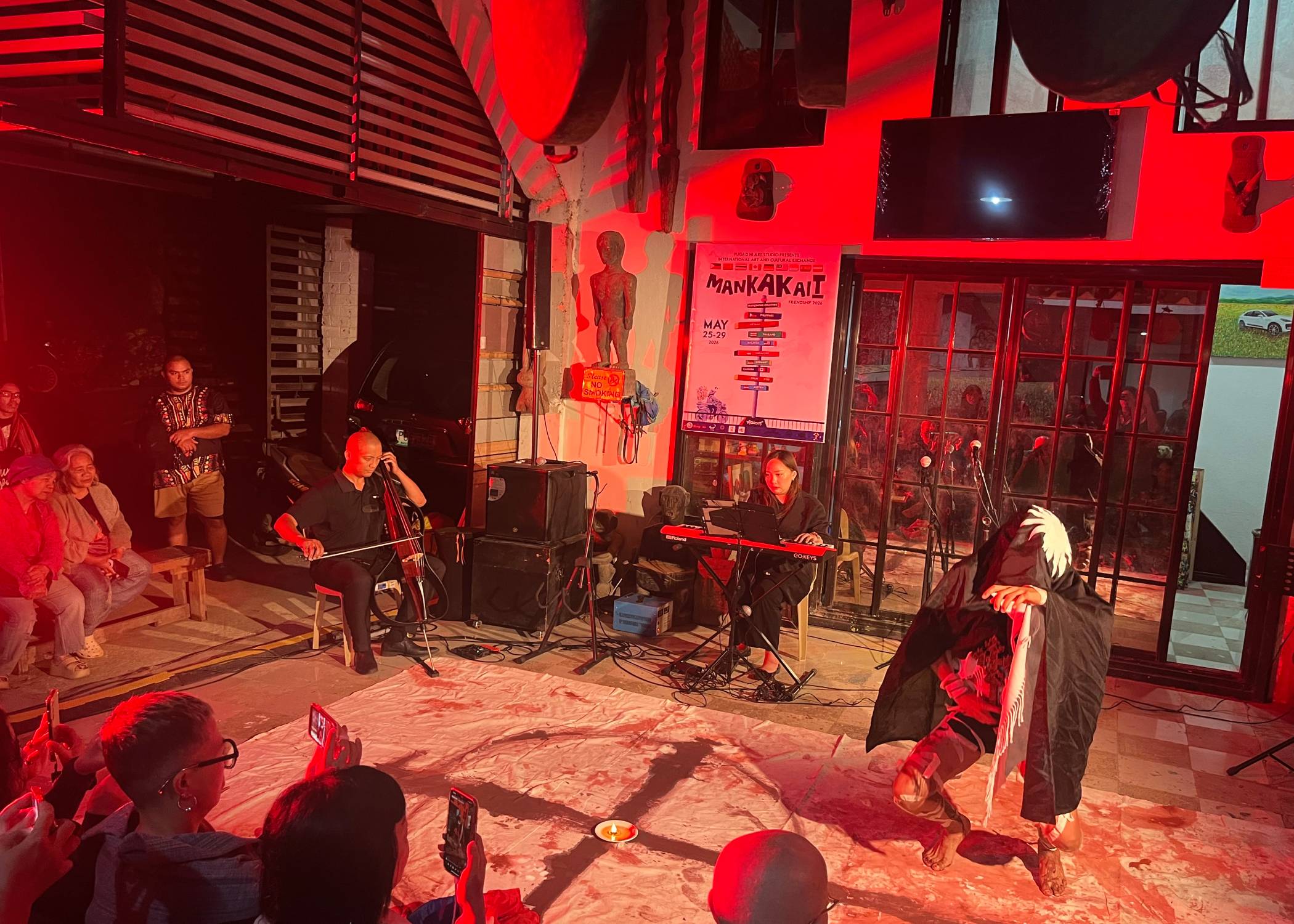
Angelo Aurelio, in a butoh collaboration with the cello, piano, dedicated the performance to the nation.
“I was completely overwhelmed by the energy in the room,” Aurelio said.
The three-part performance, dubbed “The Nation as a Body” and musically directed by Jessica Mirandilla with musician Eric Toledo on cello, was performed by Aurelio with slow, deliberate movements that denoted unrest.
Aurelio said, “We take the pulse of the land, the body, the nation. What can we still hold? What have we been forced to carry that was never ours? This section is stillness, listening, mapping the wound.”
Butoh (the ancient Japanese dance), is characterized by slow, contorted movements that traditionally depict darker, taboo aspects of the human psyche and postwar trauma.
From this stillness, the performance transitions into “Social Autopsy” (Dissection), described by Aurelio: “We cut open the systems, the stories, the lies we’ve inherited. No clean hands here. We name the rot, the borrowed trauma, the structures that keep us small. It’s uncomfortable, surgical, necessary.”
Finally, the performance shifts into “Subli” (Realignment), highlighted by the traditional subli becoming a rite of return—to the body, to the ancestors, to a politics of discernment.
“We don’t just survive. We choose what lives and what gets washed away,” Aurelio said.
The Butoh performance philosophy centers on gravity and downward movement, using the body to express memory, ancestry, and survival. Today, performers around the world use Butoh to physicalize internal conflict and systemic oppression.
Presented as part of the Mankakait: Friendship 2026 cultural exchange at Pugad ni Art Studio, May 28, the event was organized to explore themes of human and national endurance under historical strain while fostering cross-border solidarity and regional friendship.
“It was a privilege performing to international audiences who brought their own contexts into this shared space,” Aurelio said.
Local artists, residents, and the visiting Southeast Asian delegates entered the center of the floor, forming a circle and stomping in unison with the gongs as the performance commenced.
“We feel honored because we showcased our talent and culture to other countries like Vietnam and Thailand,” Mirandilla shared.
Aurelio is a performance artist and director based in Baguio City who focuses his work on performance art examining culture, identity, and social commentary.
Mirandilla is a musical director, arranger, and composer, while Toledo is a musician born in Mindanao and raised in Philex Mines, Benguet. He currently performs on cello, both solo and with Baguio-based musicians. By John Larry “Lala Dy” A. Agtarap, UC Intern