
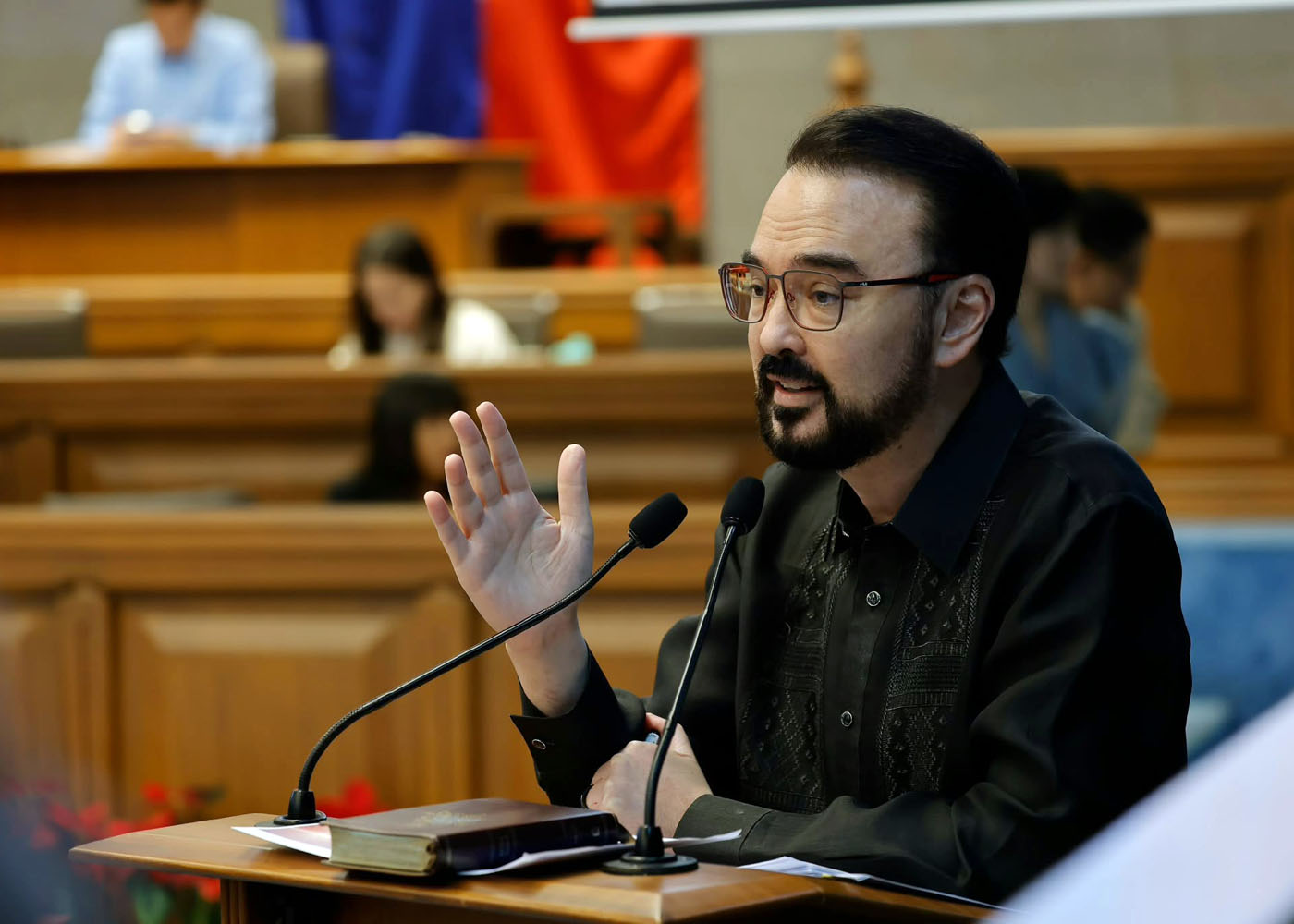
Senate Minority Leader Alan Peter Cayetano warned Monday that the Philippine government’s foreign loan agreements require stricter legislative oversight, arguing that Congress is effectively forced to fund billions of pesos in debt obligations without thoroughly vetting the projects behind them.
Speaking during Senate deliberations on the proposed P7 trillion national budget for 2027, Cayetano criticized the disconnect between the executive branch’s borrowing powers and Congress’ constitutional power of the purse.
“We have to look long-term and sustainability. I don’t think there should be a disconnect (between) the borrowing of the executive and then the legislative being forced to just approve it,” Cayetano said.
Earlier Monday, during a Commission on Appointments hearing for Commission on Audit chairperson nominee Douglas Michael Mallillin, Cayetano noted that foreign loan agreements routinely contain arbitration clauses—some requiring disputes to be settled outside the Philippines.
Once the executive branch signs a contract, the government is legally bound to pay, even if lawmakers later object to the project’s cost or necessity.
“Even if Congress said they don’t like the project and they won’t pay, (if) you signed on behalf of the Philippines and there is an arbitration clause, you still have to pay,” he said.
Cayetano pointed to a tension within the 1987 Philippine Constitution. While Article VI mandates that no money be paid out of the treasury without an appropriation law passed by Congress, Article VII authorizes the president to contract or guarantee foreign loans with the prior concurrence of the Monetary Board.
The senator cited flood control initiatives embedded in foreign-assisted loan packages as a prime example, noting that lawmakers are compelled to fund them despite Congress having slashed local allocations for flood control in recent years.
Because loan repayments and grace periods often span decades, current borrowing decisions will bind future administrations and national budgets, he added.
“This is huge amounts of money, including foreign-assisted projects, that it feels like we have no choice but to approve,” Cayetano said. “Those weren’t really scrutinized like the other parts of the 7 trillion peso national budget.”
To safeguard the country’s fiscal sustainability, Cayetano proposed studying whether the executive branch should be required to secure prior congressional approval before finalizing any foreign loan agreements.
“Think of sustainability. Should we have congressional approval before we borrow money?” Cayetano added. NLMonitor