
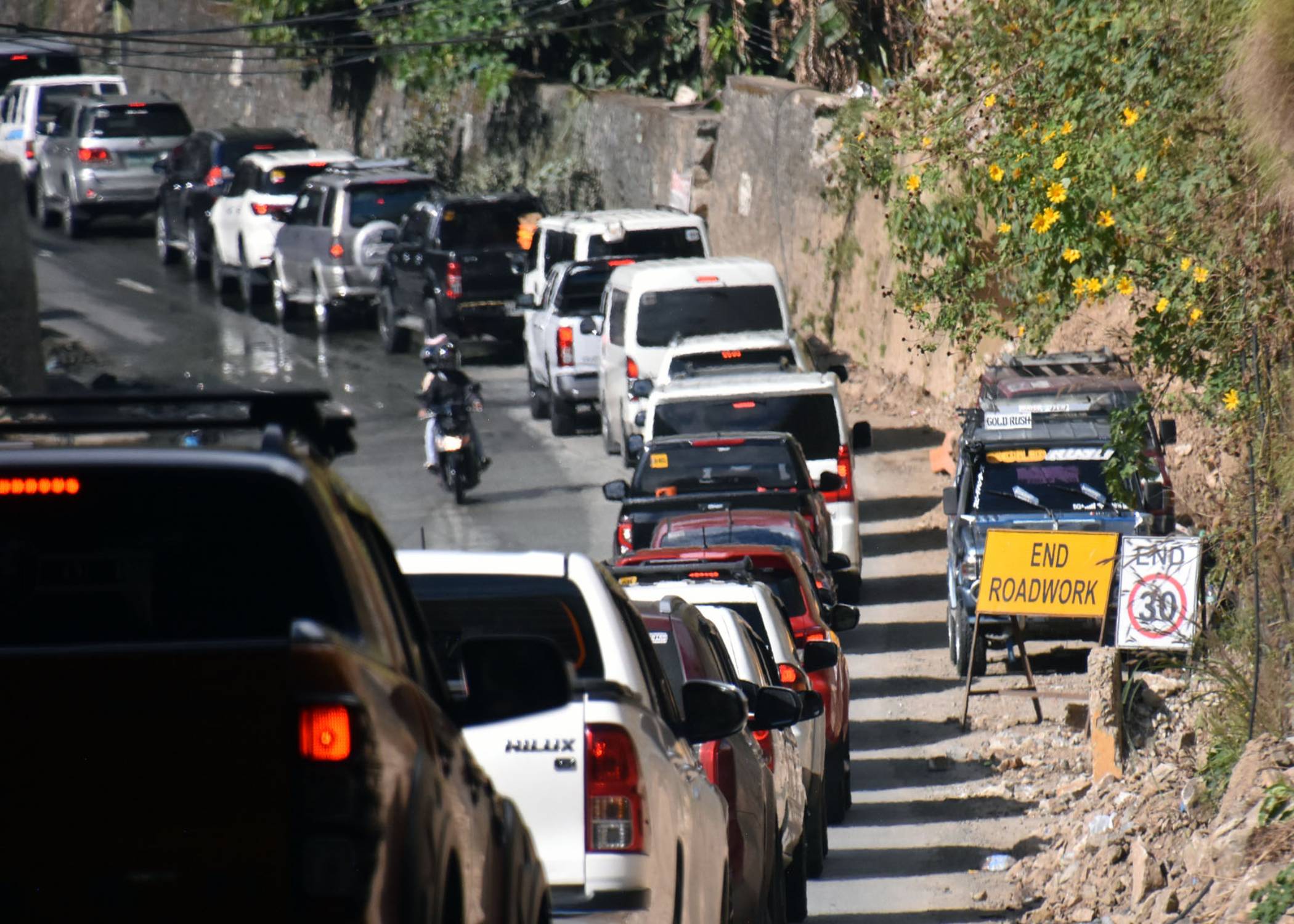
Baguio traffic is at its worst, breaching the city’s carrying capacity for vehicles.
The Land Transportation Office (LTO) revealed that registered vehicles have increased to over 60,000, posing a severe deficit against the actual road infrastructure of the mountain city.
Police Lieutenant Colonel James Allen Dogao, who serves as the Chief of the Traffic Enforcement Unit (TEU) for the Baguio City Police Office (BCPO), said, “Sa Baguio City, ang para sa vehicle carrying capacity is 15,000 to 20,000 vehicles.”
Dogao added that LTO data reveals the total number of registered vehicles, including motorcycles, within Baguio alone has soared past 60,000 to 65,000. This does not count the thousands of daily commuters from nearby municipalities and arriving tourists.
To combat this conundrum, Baguio traffic enforcement agencies are deploying drone technology to hover over major choke points on weekends to monitor vehicle queues in real time and optimize traffic flow.
Simultaneously, an inter-agency directive from the Philippine National Police, Land Transportation Office, and Department of Trade and Industry has instituted strict enforcement against noisy aftermarket exhaust pipes. Under the guidelines, any aftermarket exhaust modified by removing its built-in silencer, catalytic converter, or heat guard will be flagged as an illegal modification.
The Traffic Enforcement Unit (TEU) outlined these updated mitigation parameters during the Baguio City Hall Hour on June 17.
“I-check ng enforcers kung yung decibel reading ng exhaust pipes ay lalagpas ng 99-decibel limit at kung unauthorized yung modification. Ang ruling, ‘yung mga aftermarket pipes kung ano ‘yung itsura n’yan nung binili mo, isasalpak mo lang siya. Huwag mo na siyang pakialaman,” Dogao reminded.
While documentation checks on Certificate of Road Safety papers are temporarily on hold, 43 deputized LTO traffic officers are actively pulling over and ticketing vehicles based on physical modifications and noise levels.
As part of the wider traffic management layout, commercial establishments are warned that they face the revocation of their business permits if their customer traffic consistently overflows into public streets due to poor parking management.
Meanwhile, the city is currently pursuing feasibility studies for multi-level public parking structures to help bridge a severe 14,000-space parking deficit across the city. By Clariz Hidalgo, UC Intern