Philippine community journalism is fighting to survive.
Pia Ranada, a Marshall McLuhan fellow and Community Lead for the online news site Rappler, describes modern journalism as a struggle against algorithms that make credible news less visible.
“Journalism thrives in connection and cultivates connection. If you’re self-absorbed, you don’t care; but once you watch the news, you care—it affects you. Journalism thrives in that caring,” Ranada said. “You’re more than just your feed; there’s a world beyond it. Connection is the antidote to the journalism crisis.”
The Rappler journalist highlighted the challenges of responsible reporting in the digital age, specifically the rise of “AI slop”—low-quality, AI-generated content that floods platforms, creating noise and distracting readers. According to Ranada, this influx has profoundly changed consumption habits, drastically reducing traffic to news publishers and straining their financial operations.
“What journalism needs isn’t simply journalists who know how to write a headline or lead; it needs marketing professionals. We need to sell our stories and their packaging. Journalism is changing, and we need to change our mindset, too. We need new ideas and young people to match Gen Z’s behavior—they are the next consumers of news,” Ranada said.
With a dwindling economic system and a rapidly shifting technological landscape, local newsrooms face rising costs and unsustainable revenues. This has forced many to downsize, transition fully online, or shut down entirely. A 2021 report by the National Union of Journalists in the Philippines (NUJP) showed that the transition to digital media has led to the closure of multiple newsrooms, leaving communities with limited news sources and deepening media concentration.
Ranada recalled Rappler’s own struggle, noting that the organization had to rely on grants and membership subscriptions to survive, especially after facing financial strain due to legal cases over alleged foreign ownership.
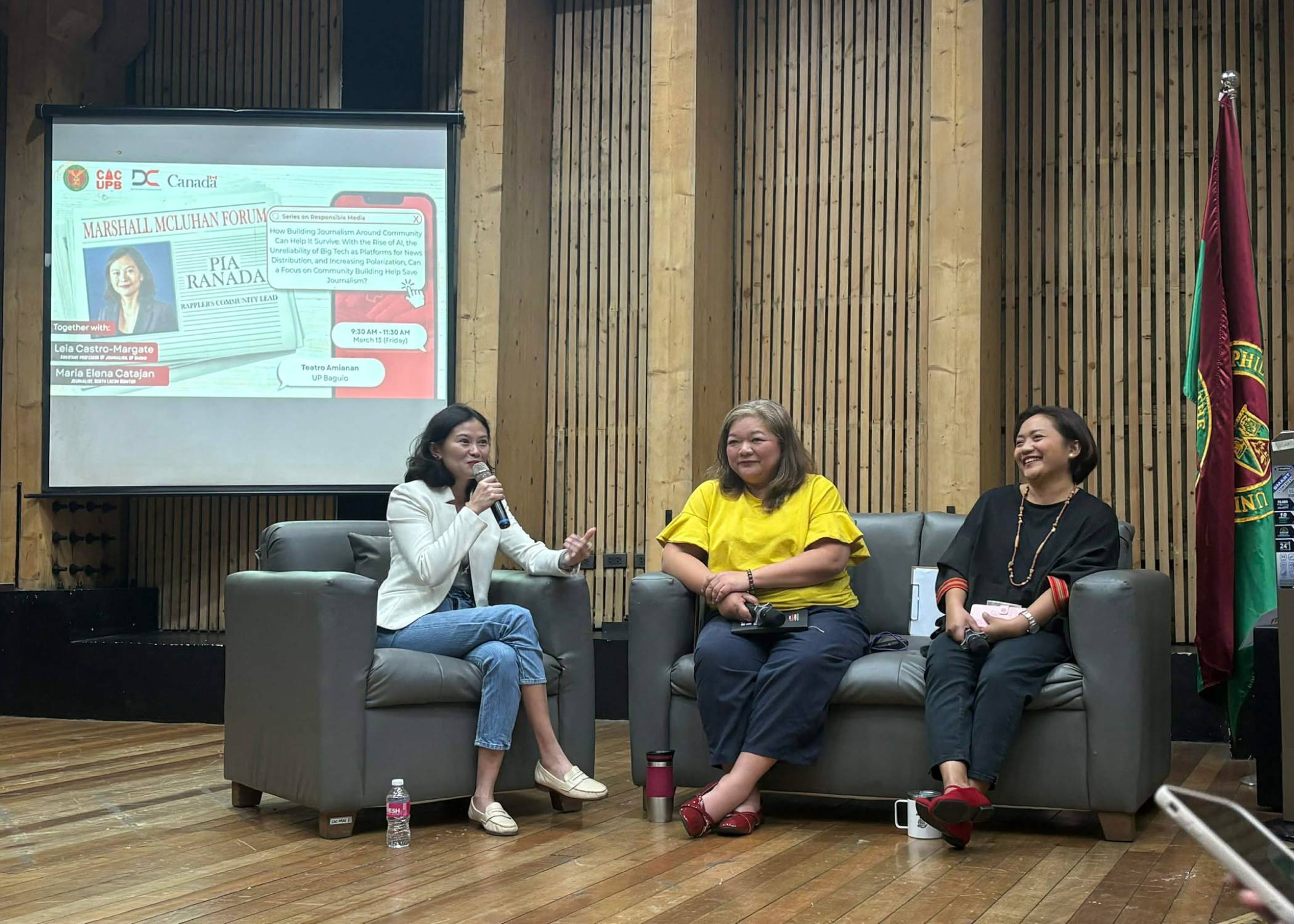
Speaking at the Marshall McLuhan Forum on March 13 at the University of the Philippines (UP) Baguio, Leia Margate-Castro, an Assistant Professor of Journalism, emphasized the struggle of local publications in the Cordillera region. She pointed to the closure of the Baguio Midland Courier, which ceased operations after 77 years as a primary news source. Similarly, the shutdown of SunStar Baguio after 30 years left its entire news team without benefits or compensation following a shareholder pullout.
This crisis coincides with a decline in students pursuing the craft. Maria Elena Catajan, a journalist for the North Luzon Monitor and a professor at the University of the Cordilleras, observed that while students today can craft social media captions, many struggle with basic news writing.
“Administrators and universities, public and private, are complaining—enrollments are low, and students have lost interest in journalism,” Catajan said during the forum.
In January 2026, the College of Arts and Communication (CAC) at UP Baguio faced the dissolution of journalism major courses due to a failure to reach “enough subscribers,” according to an official statement. This forced journalism majors to undergo a tedious process of merging with equivalent courses to retain their academic standing.
From town halls to digital chatrooms, journalism is evolving to meet communities where they are. Ranada noted that the industry is moving beyond mere content production toward fostering a sense of purpose, belonging, and collective action.
“Something a newsroom can control is its relationship with the audience,” Ranada said, emphasizing that building trust requires being present in the community and tackling “issues that hit home.”
For Rappler, civic engagement is a vital form of connection. Through initiatives like the “Kapihan” sessions during the 2025 elections, Rappler partnered with local businesses, cafes, and schools to host town halls with candidates in Manila, Marikina, and Cavite. These sessions allowed residents to meet candidates face-to-face, turning political reporting into a community conversation.
Ranada also emphasized that fact-checking is no longer a task solely for journalists. News organizations now provide anti-scam workshops to help citizens—particularly the elderly and the youth—identify misinformation and protect their digital identities.
One highlighted innovation was the Rappler app, which features an AI chatbot designed to deliver news and foster discussion. The app acts as a public chatroom with real-time conversations and “Ask Me Anything” (AMA) sessions with experts. Its crowdsourcing features also encourage participatory journalism, allowing citizens to report local issues as they happen.
While some fear AI, the University of North Carolina at Chapel Hill suggests that AI should function as a “co-pilot”—assisting in data analysis, document processing, and SEO, rather than replacing human reporters.
“We used AI to gather data for a virtual community consultation, and that consultation informed a [car-free] ordinance in Quezon City that was eventually passed,” Ranada explained, noting that technology allowed over 200 people to participate in the process.
Catajan added that the North Luzon Monitor is also creating guidelines for AI use: “It’s about using AI to your advantage,” she stated, encouraging journalists to use technology responsibly.
Ultimately, Ranada points out that journalism must be compensated. Investigative reports that hold the powerful accountable are expensive; they require documents, travel, and hours of legwork that “psychological wealth” cannot fund.
Using the Rappler+ membership model as an example, news organizations are striving to survive through direct reader support. By engaging with readers willing to provide funding, publications are proving that the bond between journalists and their audience is a bulwark against financial instability.
For the industry to thrive, Ranada expressed that the community must move beyond passive interest and support the business models that allow journalists to work.
“It’s about enjoining the community to understand the industry,” Catajan added. “It’s about a community of people who are now with us, not just reading us or giving leads. It’s about a collective effort to keep journalism alive.” By Lyndee Buenagua, Dianne Ysabel Mallare, Caryl Sumulong, UP Baguio Interns